Put Embassy Sky Terraces vs White Lotus Amanvana in front of ten buyers and you will get ten different answers, because the two projects are not really competing on the same axis. Embassy is building four G+23 towers holding 615 residences on 10.5 acres in Hebbal, immediately alongside the Lake Terraces address that has been sold out for years. White Lotus is building 95 row villas across 14 acres on IVC Road in Devanahalli, organised around a Balinese principle that pairs personal space with the flow of water. Both are aimed at the corner office and the returning NRI. Neither is a substitute for the other.
Two Answers To The Same North Bengaluru Luxury Question
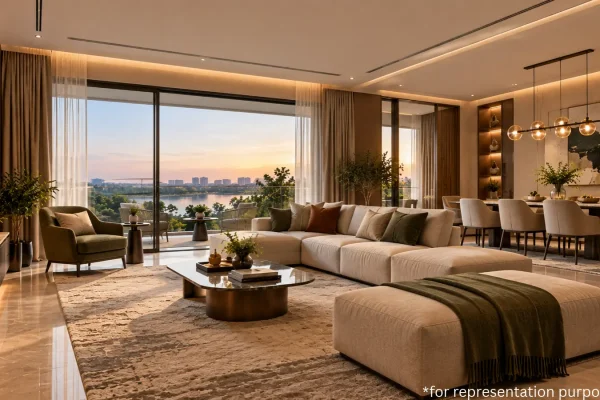
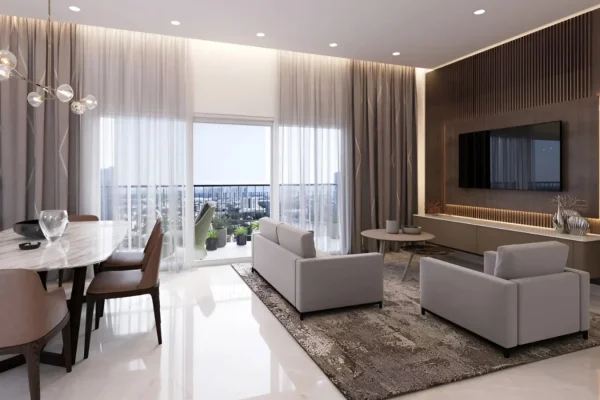
The question both developers are answering is what a ₹5 to ₹7 crore home should feel like in 2030. Embassy answers it vertically. Sky Terraces keeps only seven units on each floor, holds 75% of the site open, and sets a 2.4-acre vehicle-free podium at ground level so that the entire resident experience above the basements is pedestrian. Residences run 2,090 sft, 2,469 sft and 2,936 sft, with a jodi combination in Tower 1 producing a 4,939 sft five-bedroom home. White Lotus answers it horizontally. Amanvana places 95 villas at seven homes per acre, each about 4,000 sft over three levels on a 2,400 sft plot, with staggered micro-clusters of two or three villas around shared courtyards and a pedestrian-first internal network replacing conventional road planning.
Why The Format Choice Matters More Than The Price Tag
Buyers tend to lead with ticket size and then discover that format governs everything downstream. An apartment at Sky Terraces arrives serviced — concierge, common maintenance, a managed clubhouse, security handled at the gate and the lobby, and the ability to lock the door and leave for three months without consequence. A villa at Amanvana arrives owned. The three car parks, the private elevator, the roughly 5,000 sft of undivided land share and the private lawn or terrace garden all belong to the household outright, and so does responsibility for much of the upkeep. That trade repeats across resale, insurance, financing and even how easily the home can be modified later. It is worth resolving before either project’s per-square-foot rate enters the conversation at all.
Understanding What Each Micro-Market Has Already Priced In Today
The corridor question in Embassy Sky Terraces vs White Lotus Amanvana is really about timing: Hebbal and Devanahalli sit at different points on the same growth curve. Hebbal has already absorbed most of its infrastructure story, delivering 36.9% appreciation over one year, 72.4% over three and 126.2% over five, and contributing 22% of Bengaluru’s above-₹10 crore apartment sales in FY25. What remains unpriced is the metro interchange bringing the Blue and Red lines together. Devanahalli is earlier. Corridor apartment rates have climbed from ₹6,500–7,500 per sft in 2020 to ₹10,000–12,000 today, with roughly 20.3% growth in the last year alone and consensus projections near 12% annually through the current cycle. The aerospace SEZ, Foxconn and the STRR are still converting into occupied demand rather than announced demand.
Specification Depth Versus Space Efficiency Across Both Luxury Products
Embassy specifies more expensively; White Lotus delivers more space per rupee. Sky Terraces carries Italian marble flooring through living areas and bedrooms, Grohe or equivalent CP fittings, double-glazed panoramic sliding doors, a 3.4-metre floor-to-floor height and gypsum ceilings at 2.9 metres, backed by 100% power backup and IGBC Gold-aligned design. Amanvana specifies vitrified tiles, Jaguar or CERA fittings and polished teak entrance doors — a premium rather than ultra-luxury pack — but offsets this with 84% carpet efficiency against Sky Terraces’ 71%, smart-home automation across all 95 villas, EV-ready provisioning and a private lift sized for a wheelchair in every home. Buyers essentially choose between finish grade and usable floor area, and the right answer depends on whether they intend to renovate later.
How Timelines And Paperwork Shape The Risk Each Carries
Both projects target December 2030, but they arrive at that date from opposite directions. Amanvana holds a live Karnataka RERA registration, BIAAPA sanction from July 2025, completed land conversion, an issued E-Khatha, and NOCs from KSPCB, SEIAA and the Airport Authority of India, with construction already running against a published schedule. Sky Terraces is pre-launch, with RERA registration, plan sanction and environmental clearance still in process and bookings running as EOI submissions ranked by priority number. When comparing Embassy Sky Terraces vs White Lotus Amanvana on risk, the honest framing is that one offers documented certainty at a smaller developer, and the other offers a thirty-year execution record with the paperwork still catching up to the marketing. Both positions are defensible; they simply suit different temperaments.