Comparisons on the North Bangalore corridor usually founder on format. A villa against an apartment is not really a comparison, just a sorting exercise dressed up as one. This pairing is more interesting, because both projects are detached villa communities running at densities well below the regional benchmark, and both address a buyer with eight figures to commit.
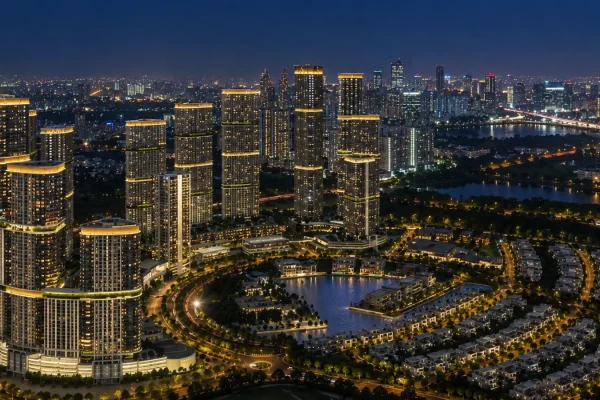
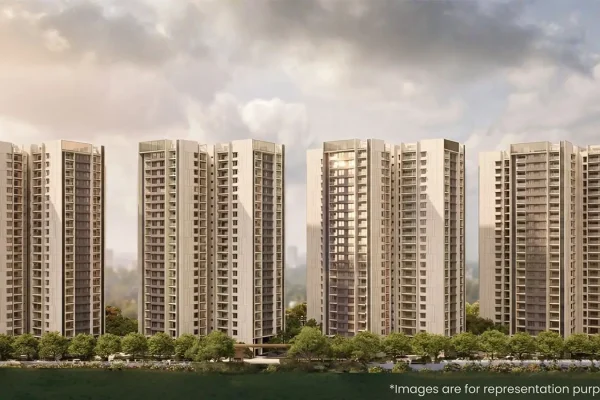
Embassy Riverine places 218 villas across fifty acres at the protected core of a two-hundred-acre township at Tharahunise, fifteen kilometres from the airport. White Lotus Kandavara places 90 villas across roughly thirty acres in the Kandavara village belt of Chikkaballapur, a kilometre from a lake, with the Nandi Hills range on the south-western view axis and the terminal thirty kilometres away.
Anyone working through Embassy Riverine Villas vs White Lotus Kandavara is therefore not asking which villa is better built. They are asking whether the home is where the week happens or where the weekend does — and that question resolves the rest.
Land Per Villa Where the Two Formats Genuinely Separate
Embassy Riverine, with Alok Shetty Architecture as the practice of record, runs three configurations across its parcel. Forty-eight villas take the 4 BHK at 4,185 square feet with three car parks. A hundred and thirty-seven take the 4.5 BHK at 5,237 square feet with four parks, and that tier is the commercial and architectural centre of the enclave. Thirty-two take the 5 BHK at 6,820 square feet with six parks, capped deliberately to preserve trophy scarcity.
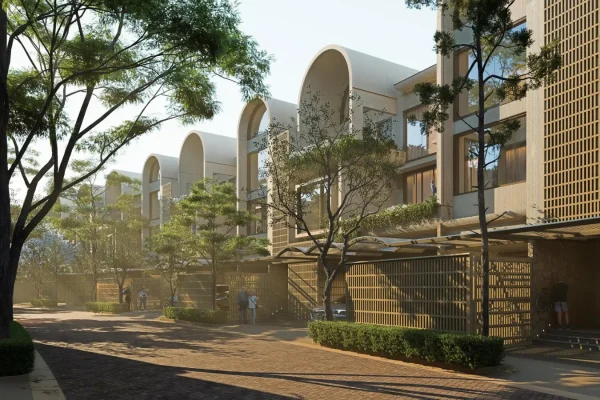
Every home is offered east-facing or west-facing across two levels plus a terrace. A private garden strip runs alongside, and an L-shaped rear garden wraps two faces of the villa rather than sitting behind it as a single rectangle. That wrap is the signature move, and it is what makes the outdoor space usable from more than one room rather than viewable from one.
Density carries the rest of the argument. Two hundred and eighteen villas across fifty acres works out to roughly 4.4 per acre, against the eight to ten at which conventional Bangalore luxury villa colonies operate. The arithmetic converts into wider internal streets, deeper setbacks, real distance between adjacent structures, and enough soil area for a canopy that will mature across fifteen to twenty years.
White Lotus takes the same principle and pushes it further than almost anything in the region. Ninety villas across approximately thirty acres works out to about three per acre, or roughly fourteen and a half thousand square feet of gross site area per home — exceptionally high for a gated villa community in Bangalore, where most comparable developments deliver six to twelve villas per acre. Plots run four thousand to six thousand square feet, and the villas carry full setbacks on all four sides with no shared walls at all, which is what gives the scheme its stated villa-mansion character.
The inventory splits three ways. Standard villas at 4,800 square feet built-up on 4,000 square foot plots take roughly half the project, laid out as 4 BHK with a family lounge and staff suite over ground, first and terrace. Large villas at 5,000 to 5,200 square feet take about thirty per cent and add a study or media room, an expanded master with lounge, and a private terrace on one of the secondary bedrooms. Signature lake-facing villas at 5,300 to 5,500 square feet on plots of 5,500 to 6,000 take the remaining fifth, stepping up to 5 BHK with primary frontage to the lake or the hill view-axis and a plunge-pool or garden-cabana option to be confirmed at launch.
One point cuts against the intuitive reading. Lower density does not mean larger houses here — Riverine’s 5 BHK at 6,820 square feet remains the largest single home in this comparison by a clear margin. White Lotus wins decisively on land per villa and on the privacy that buys, not on built-up ceiling.
Fifteen Kilometres to Work Against Thirty to Almost Everything
The location gap is the substance of the comparison, and it runs consistently in one direction rather than trading off.
Riverine sits inside an active employment and institutional belt. Prestige Tech Cloud is at 6.5 kilometres, IFCI Financial City at twelve, KIADB Aerospace Park at 18.5 and Embassy Manyata Business Park at twenty, with the township carrying its own Grade A commercial precinct inside the gates. The everyday layer sits closer still — Stonehill International School at roughly 2.5 kilometres, the Padukone-Dravid Centre for Sports Excellence at three, Vidyashilp Academy at eight, Canadian International School at ten, Cytecare Cancer Hospital at ten and Manipal Hospital Yelahanka at 11.5.
White Lotus trades all of that for setting, and the setting is genuinely distinctive. Kandavara Lake sits about a kilometre away, the Skandagiri trek base at twelve, the Nandi Hills base at fourteen, Muddenahalli at eight and the Sadhguru Sannidhi campus at ten, within a rural-edge landscape of mulberry orchards, vineyards and silk-cultivation fields. Chikkaballapur town centre lies four kilometres out and carries a district hospital and general multi-specialty options at around five, with the railway station at five.
Beyond that immediate ring the distances lengthen sharply, and the project’s own documentation does not disguise it. The KIADB Aerospace SEZ sits at twenty-five kilometres, the airport at thirty, Stonehill International at twenty-eight, Embassy Springs and Brigade Orchards at twenty-five to twenty-eight, Yelahanka at forty, Hebbal at forty-eight, Aster CMI and Columbia Asia at around fifty, and Manyata Tech Park at fifty-two, with the CBD at sixty. The stated position is that the STRR and metro build-outs are progressively addressing this rather than that it is already solved, which is an honest framing worth taking at face value.
One Publishes Its Price, the Other Publishes Its Name
Here the usual pre-launch pattern inverts, and the inversion matters more than either project’s marketing suggests.
Embassy Riverine does not publish rates. Pricing is released against enquiry, with the final cost sheet confirmed at booking under K-RERA carpet-area disclosure — defensible across 218 villas where position within the enclave, orientation, garden depth and landscape adjacency each carry differentials that a single headline rate would misstate. What it does publish is everything else: configurations, saleable areas, car-park allocations, orientation options, a detailed specification schedule and an indicative possession window from 2030 onwards.
White Lotus does the reverse. Indicative pricing is anchored at roughly eighteen thousand rupees per square foot, which places the entry ticket at approximately eight crore sixty-four lakh on the 4,800 square foot standard villa, nine crore on the large villa and around nine crore ninety lakh on the signature lake-facing typology. Karnataka stamp duty and registration run about 7.66 per cent with GST at five per cent, and club membership is bundled as a one-time charge at booking.
But the developer is undisclosed. White Lotus Kandavara is a codename project, with the brand and entity details released only at formal launch and RERA registration. That is the single most material verification gap in this comparison. Embassy’s delivery record across Manyata Business Park, Tech Village and GolfLinks is a genuine underwriter of completion probability at scale; a codename carries no equivalent to assess until the entity is named, however sound the product on paper.
Approvals sit incomplete at both, with one extra layer at Kandavara. Riverine’s Karnataka RERA registration is in progress with plan sanction in process. White Lotus carries RERA registration pre-launch, DTCP or local authority plan sanction in process, and KSPCB environmental clearance in process. At either project the discipline is the same — hold at EOI until the registration number is live on rera.karnataka.gov.in, and treat every pre-registration figure, including the eighteen thousand per square foot anchor, as indicative rather than committed.
Why Both Answers Are Sound for Different Households
Riverine is calibrated for a principal residence held across twenty-five to forty years. Nineteen acres of reserved landscape spine threading the residential precinct, a forty-thousand square foot clubhouse with a heated indoor pool and spa wing, an eighty-foot spinal road with villa streets branching off it, three to six car parks by configuration against the two-park default most Bangalore product allocates, and staff rooms with attached toilets and separate service entry in every configuration are the concerns of daily living rather than occasional use. The township adds what a standalone enclave structurally cannot — an operator with an ongoing commercial stake at the address decades after the last handover, which is the real backbone of maintenance discipline.
White Lotus is calibrated for the second home, and states that intent openly. Its stated buyer is someone seeking a holiday or weekend property, or an HNI or NRI investor targeting one of Karnataka’s strongest appreciation corridors. The case rests on four things that hold up: ultra-low density at three villas per acre, genuine villa-mansion scale rather than the compressed footprints typical of recent gated launches, a lake-and-hill setting no Devanahalli comparable can match, and an entry rate positioned at a discount to the Devanahalli luxury villa band of eighteen to twenty-five thousand per square foot, with the structural upside of the corridor closing that gap as it builds out.
Framing Embassy Riverine Villas vs White Lotus Kandavara as a ranked contest misreads both products. One is a residence inside a working corridor with a named developer and a known specification. The other is a retreat with exceptional land allocation, real appreciation headroom and an unnamed builder — and both of those descriptions are accurate at the same time.